What Do Iveco Bus Names Mean? (Crossway, Urbanway, Evadys and the -way Family)
Walk into any European bus depot and you will trip over them: white-and-blue interurban coaches with a stubby front, a high floor, and a badge that reads Crossway. Most passengers never register the name. Most enthusiasts can rattle off a Mercedes Citaro or a MAN Lion's City long before they mention it. Yet the Iveco Crossway is, by the manufacturer's own count, the single most-sold intercity bus on the continent — a quiet giant hiding behind a name almost nobody decodes.
And there is a logic to that name. Iveco Bus builds its passenger line-up around a tidy suffix system: the -way and -ys endings tell you, at a glance, what the bus is for. Once you see the pattern, the whole catalogue reads like a sentence. Here is how it works — and the tangled Irisbus history that produced these badges in the first place.
The -way logic: the suffix predicts the job
Iveco's two core service buses both end in -way, and the prefix is the entire message. Urbanway is the urban one — a low-floor city bus for stop-and-go transit. Crossway is the one that crosses the gaps between towns — an interurban, intercity, and school-service workhorse. Same suffix, opposite missions, and you can read which is which from the name alone.
That is unusually honest naming. Where some makers bury the bus's role in a number, Iveco front-loads it in a word. The two touring coaches break the pattern slightly — Evadys and Magelys swap to an -ys ending — but they hold to the same idea: the badge tells you the use case before you ever see the floor height.
Urbanway — the low-floor city bus
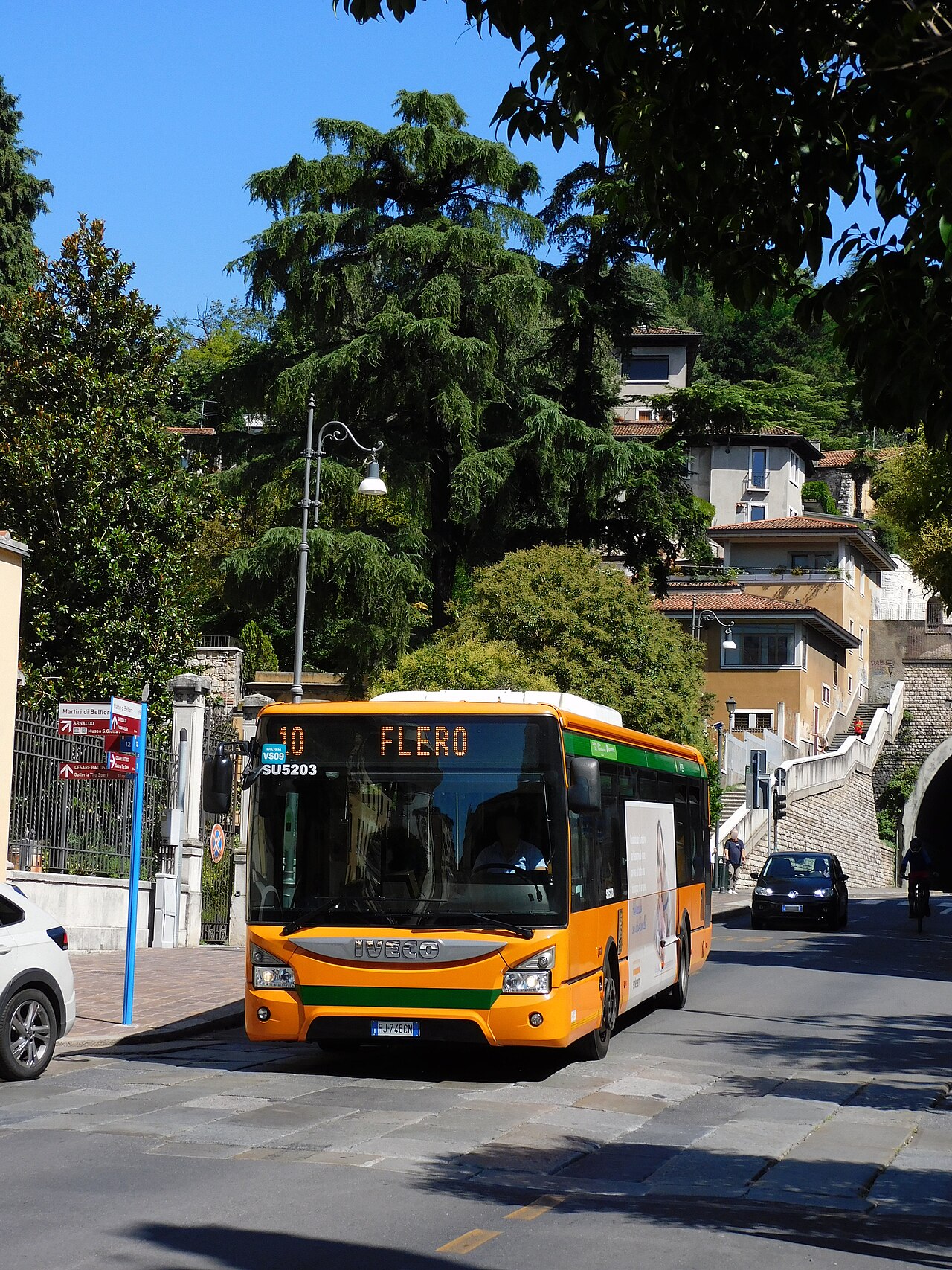
The Urbanway is the bus you board on a city route. Launched in May 2013 at the UITP World Congress — the same moment the Iveco Bus brand itself was unveiled — it replaced the long-running Irisbus Citelis as the company's standard low-floor transit bus. Lighter and slightly roomier than its predecessor, it arrived built for the Euro 6 era with Fiat Powertrain's Tector and Cursor engines.
Everything about the Urbanway is tuned for short hops and heavy churn: a step-free low floor, a kneeling function that drops the entrance to the kerb, wide multi-leaf doors, and a low centre of gravity that keeps it composed through constant braking and accelerating. It comes in 10-, 12-, and 18-metre (articulated) lengths, with diesel, CNG, and hybrid drivelines.
Crossway — Europe's quiet best-seller
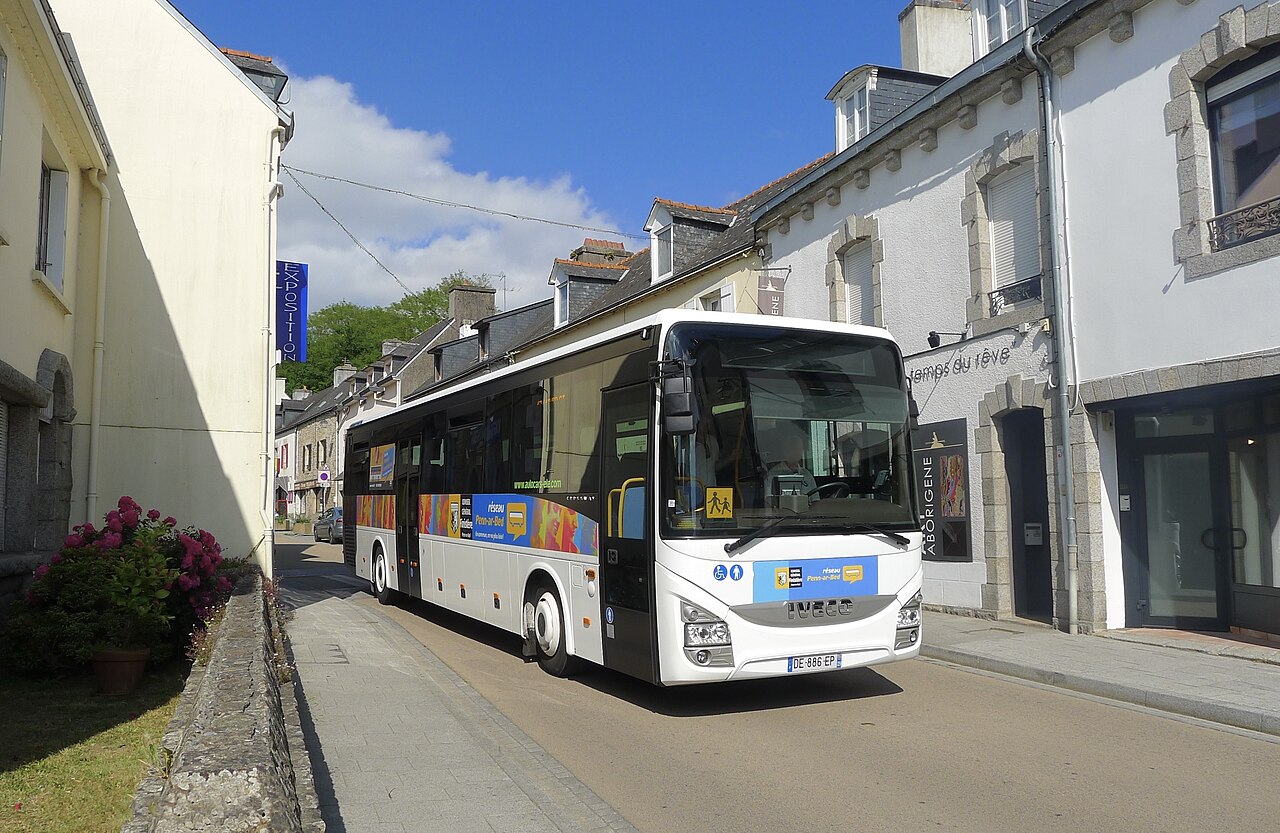
If the Urbanway is the city bus, the Crossway is the one that crosses the spaces in between — the regional service that links one town to the next and runs the morning school routes. Iveco describes it bluntly as "designed for interurban and school transport," and it is the foundation of the company's intercity offer.
It is also, remarkably, a sales phenomenon hiding in plain sight. Launched in 2006, the Crossway crossed 60,000 units produced in 2023, and Iveco Group calls it "the best-selling intercity bus in Europe." It is built at the Vysoké Mýto plant in the Czech Republic — a bus factory whose lineage we will get to shortly. The range spans roughly 10.8 to 14.5 metres across its variants, with diesel, CNG, hybrid, and even battery-electric high-floor versions.
Mechanically the Crossway is the opposite of the Urbanway. It is a high-floor design — passengers climb a step or two at the door — which raises the saloon for luggage space underneath and suits steady cruising over town-to-town distances rather than rapid kerbside loading. That high floor is the visual tell: if the entrance has steps and the body sits tall, you are almost certainly looking at a Crossway, not an Urbanway.
Evadys and Magelys — the touring coaches
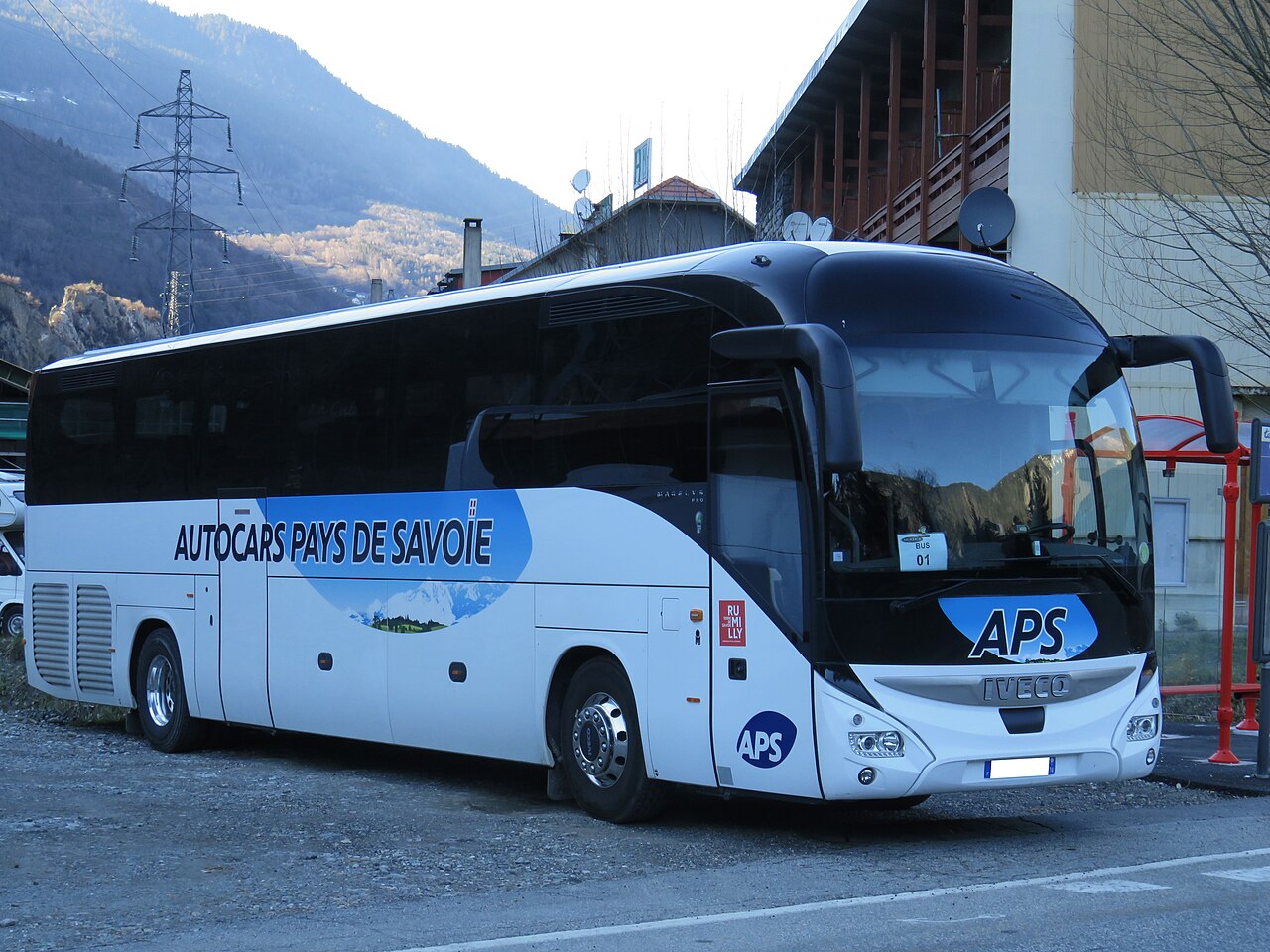
Above the service buses sit the two coaches, where Iveco switches to the -ys suffix. The Magelys is the flagship: a high-floor (HD) touring coach pitched at sightseeing and grand-tourisme work, with the saloon lifted high over a deep luggage bay. The Evadys slots in just beneath it, a mid-floor coach Iveco positions for "regional and national routes, as well as local and mid-distance tourism services" — more comfort and luggage than a plain intercity bus, but lighter and thriftier than the full HD Magelys.
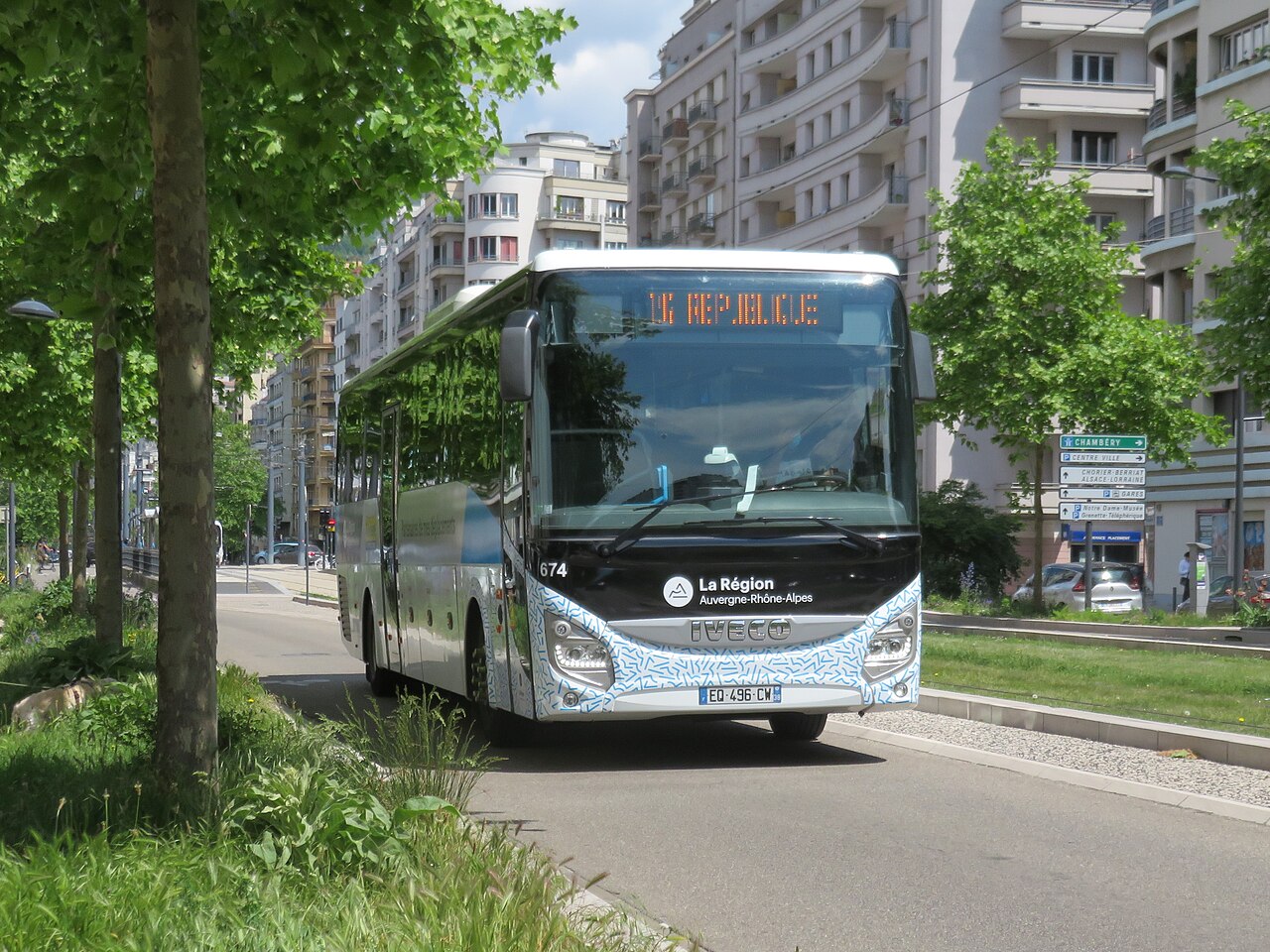
Stack the four together and the floor height climbs with the ambition of the journey: Urbanway (step-free, kerb-level) → Crossway (normal high floor, interurban) → Evadys (raised mid-floor coach) → Magelys (full HD touring floor). The badge is a shorthand for where on that ladder the bus belongs.
The Irisbus heritage behind the badges
None of these names predate this century — and the company that coined them was itself a fusion. Iveco (Industrial Vehicles Corporation) was founded back in 1975 from five European truck and bus makers, Fiat's Veicoli Industriali among them. The bus story proper begins in 1999, when, in Iveco Group's words, "IVECO and RENAULT V.I. joined forces to develop their coach and bus activities, establishing IRISBUS, the second-largest European manufacturer."
Irisbus was a melting pot. The alliance "brought together French, Italian, Spanish, Czech, and Hungarian expertise, uniting under one banner the brands IVECO, Pegaso, Orlandi, Renault, Heuliez, Ikarus, and Karosa." That Czech name — Karosa — matters: its Vysoké Mýto plant, building buses since the 1890s, is exactly where the Crossway rolls off the line today. The continent's best-selling intercity bus is built on more than a century of one factory's coach-making.
Renault stepped away over the following years, and Iveco took full control. Then, in 2013, the Irisbus name was retired: as Iveco Group puts it, "In 2013, IVECO BUS, replacing the name IVECO-IRISBUS, became the new brand dedicated to passenger transport." That same year brought the Urbanway and the modern -way identity. So the badges you read today are barely a decade old — but the engineering underneath them traces straight back through Irisbus to Karosa, Renault, and Fiat.
What it means behind the wheel of a sim
This is where the naming earns its keep for anyone driving these buses in a simulator. The suffix predicts the feel, not just the spec sheet.
- An Urbanway loads fast. Step-free floor, kneeling, wide doors — dwell times at a stop are short, and the low centre of gravity keeps it planted as you stab the throttle away from the kerb. It is a stop-and-go machine, and it drives like one.
- A Crossway cruises. The high floor and heavier interurban build mean it is happier holding a steady speed between towns than sprinting between bus shelters. You feel it in the slower door cycle and the more deliberate pull-away after each stop.
- The coaches commit fully to distance. Evadys and Magelys trade kerbside agility for ride comfort and luggage capacity — the floor is up high, the journey is long, and dwell time barely matters.
If you have driven Iveco's older Irisbus city buses in Proton Bus Simulator, you have already felt the urban end of this lineage. For more on why low floors changed city driving, see our piece on the low-floor revolution; for the deeper split between a city bus and a coach, coach vs city bus lays it out. And if you enjoy this kind of badge-decoding, what MAN's bus codes mean runs the same exercise on a very different naming system.
Frequently asked questions
What is the difference between an Iveco Urbanway and a Crossway?
The Urbanway is a low-floor city bus for urban transit; the Crossway is a high-floor interurban bus for regional and school routes. The suffix is the giveaway — "urban" versus "cross" (as in crossing between towns).
Is the Iveco Crossway really Europe's best-selling bus?
Iveco Group describes it as "the best-selling intercity bus in Europe," and it passed 60,000 units produced in 2023. That claim is specific to the intercity segment, not all buses of every type.
What is the difference between the Evadys and the Magelys?
Both are touring coaches. The Magelys is the high-floor (HD) flagship for sightseeing and long-distance tourism; the Evadys is a lighter, mid-floor coach positioned between the Crossway and the Magelys for regional and mid-distance work.
What was Irisbus?
Irisbus was the bus and coach joint venture formed in 1999 by Iveco and Renault V.I., later folding in brands such as Karosa and Ikarus. Iveco took full ownership and retired the Irisbus name in 2013, rebranding the division as Iveco Bus.
Images via Wikimedia Commons: Iveco Bus Crossway at Pont-Aven by Guillanst (CC BY-SA 4.0); Iveco Bus Urbanway (Arriva Italia) by Moliva (CC BY-SA 4.0); Iveco Magelys (Autocars Pays de Savoie) by Anthony Levrot (CC BY-SA 4.0); Iveco Evadys by LucieTC (CC BY-SA 4.0).