Skip to content
Bus mod development workshop — work in progress

Bus mod projects in development for Proton Bus Simulator

Follow the chassis, bodystyles and operators we're building for Proton Bus Simulator Road & Urbano. Progress is updated as each project hits a new milestone, so check back to see what's next in the public catalog.

Volvo 9700 TX Coach Bus — work-in-progress mod (for Proton Bus Simulator Road, Coach, Sweden)
In Development

Volvo 9700 TX Coach Bus

Proton Bus Simulator Road Volvo Coach Sweden
By Bus Simulation Channel
The Volvo 9700 is the intercity coach family Volvo Buses launched in 2001 to consolidate and replace the earlier Carrus Star and Vector/Regal lines. Built on the Volvo TX platform — the designation carried over into this project's title — it visually inherited the silhouette of the Carrus Star while standardising production across three height variants (9700S at 3.42 m, 9700H at 3.61 m and 9700HD at 3.73 m, with the S sold exclusively in the Nordic countries). Original assembly happened at the Carrus Oy plants in Lieto and Tampere, Finland; from 2003 onward Volvo Polska in Wrocław joined the programme for H and HD bodies, and the platform was offered with either the B12B rear-engine or B12M mid-engine Volvo chassis for Nordic operators.

For Proton Bus Simulator Road this project targets the long-haul driving behaviour of the 2001 to 2007 first-generation 9700: the TX platform tuning, the practical difference between a rear-engine and a mid-engine Volvo chassis under sustained highway running, and the cabin geometry that defined the family before the 9700 NG redesign rolled out in 2007.

Status: based on the operator-published notes the active phases are 3D dashboard and tachograph recreation, body geometry fixes from the previous milestone, and passenger animation work. No firm release date yet; the gate is the cabin polish and the animation pass before the coach ships.
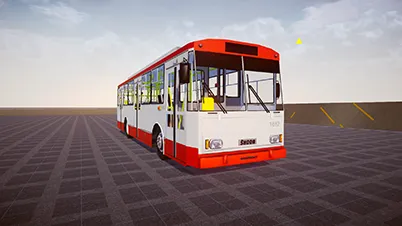
Škoda 14Tr Trolleybus — work-in-progress mod (for Proton Bus Simulator Urbano, Trolleybus, Czech Republic)
In Development

Škoda 14Tr Trolleybus

Proton Bus Simulator Urbano Škoda Trolleybus Czech Republic
By Bus Simulation Channel
The Škoda 14Tr is the Czechoslovak two-axle, three-door electric trolleybus that defined urban transit across the Eastern Bloc through the 1980s and 1990s. After the Karosa ŠM 11 / Škoda T 11 merger attempt failed and the 13Tr project was cancelled, the 1973 oil crisis pushed Škoda to revive trolleybus development; series production started in 1981 and ran until 1998, with 3,265 units built across the full programme. Kyiv received the single largest fleet at 354 units, and between 1994 and 2004 a Škoda / AAI Corporation joint venture assembled another 297 14Tr-based vehicles in the United States for Dayton, Ohio and San Francisco — a rare Czechoslovak transit export onto North American streets.

For Proton Bus Simulator Urbano this project targets the specific character of high-density Eastern European electric urban service: the silent line acceleration of an Škoda traction motor under load, the way the unibody chassis carries standing-passenger weight through tight city corners, and the dashboard layout of a vehicle designed when Czechoslovak operators still ran trolleybus fleets at heavy peak headways.

Status: based on the operator-published notes the project is in the active 3D modeling phase — exterior body details and dashboard recreation are the current focus. Audio capture for the traction motor and overhead pickup contact sequence is queued. No firm release date yet; the gate is the cabin audio polish before the trolleybus ships.
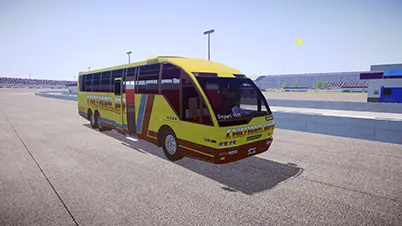
Metalsur Starbus 2 — work-in-progress mod (for Proton Bus Simulator Road, Coach, Argentina)
In Development

Metalsur Starbus 2

Proton Bus Simulator Road Scania Coach Argentina
By Bus Simulation Channel
The Metalsur Starbus 2 was the second-generation entry in the Starbus coach line built by Metalsur Carrocerías S.A. of Rosario, Argentina — an intercity bodybuilder active since 1989 whose lineage runs from the Arrow 405 of 1995 through the Arrowliner 4.05 and the first Starbus 405 of 2006, before this Starbus 2 generation was presented around 2012. Common chassis fitment was the Scania K380 in a tag-axle 6x2 layout, and Starbus 2 units in 405-bodystyle configuration entered the fleets of Argentine long-distance operators including Central Argentino and Flechabus on continental-scale highway services. The Starbus 3 that followed in 2016 arrived under Marcopolo's shareholder control, which absorbed Metalsur as the Brazilian-influenced redesign rolled out.

For Proton Bus Simulator Road this project targets the long-haul driving behaviour of a Starbus 2 on a tag-axle Scania K380 chassis — load transfer on high-speed sweepers under the body weight, the K380 acoustic profile under sustained highway running, and the cabin layout that defined the second generation before the Marcopolo-era Starbus 3 replaced it.

Status: external modeling and the chassis silhouette are advancing. The current focus is the interior compartment recreation and the K380 sound mix across the operating range. No firm release date — the gate is cabin audio polish before the coach ships.
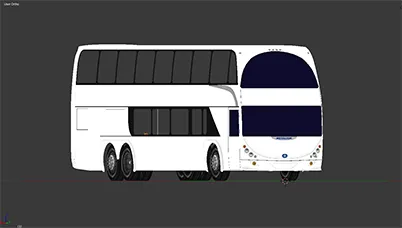
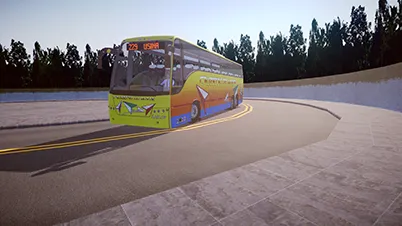
Aerobus — work-in-progress mod (for Proton Bus Simulator Road, Coach, Argentina)
In Development

Aerobus

Proton Bus Simulator Road Scania Coach Argentina
By Bus Simulation Channel
The Aerobus was a short-run Argentine intercity coach built by Carrocerías Necochea, the workshop of Miguel La Torre in the Buenos Aires-province city of Necochea, between 1985 and 1986. Only fourteen units were ever manufactured, almost all of them mounted on three-axle Scania K112 chassis without turbo — the body was light enough that the K112's six-cylinder 300-HP diesel did not need forced induction to achieve the operator-reported 10 percent fuel-economy improvement over comparable Argentine coaches. The bodywork applied aircraft construction techniques: an aluminium monocoque shell, fixed oval windows with airplane-style blinds, and a hermetic interior — the source of both the official Aerobus name and the popular nicknames Galáctico and Bus Bala that followed the units across Argentine highways during the late 1980s.

For Proton Bus Simulator Road this project targets the engineering identity that made the Aerobus a one-of-a-kind in South American intercity service: the K112 chassis behaviour with an unusually light superstructure, the non-turbo six-cylinder Scania acoustic profile, and the panoramic geometry of the aircraft-derived cabin.

Status: external modeling and the aluminium-shell silhouette are progressing through the visual lock phase. The current focus is on the fixed oval glazing geometry and the K112 sound mix across the operating range. No firm release date — the gate is interior polish before the chassis ships to closed beta.
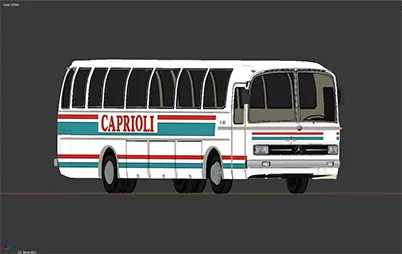
Mercedes O-302 Coach bus — work-in-progress mod (for Proton Bus Simulator Road, Coach, Germany)
In Development

Mercedes O-302 Coach bus

Proton Bus Simulator Road Mercedes-Benz Coach Germany
By Bus Simulation Channel
The Mercedes-Benz O302 was a long-haul coach chassis manufactured at the Mannheim plant between 1965 and 1974, designed in an austere Bauhaus style and sold in roughly 32,000 units worldwide across its production run. The platform adapted to multiple lengths up to 12 metres and supported luxury intercity configurations of up to 53 seats, with chassis kits exported to Latin America and Africa where regional bodybuilders fitted local coachwork. The O302 rose to broad public visibility during the 1974 FIFA World Cup in West Germany, when the sixteen competing national teams were transported in O302 units each painted in their country's colours; international assembly also reached South Korea, where Hyundai licensed the platform for express-bus production between 1972 and 1976, and Turkey, where roughly 14,430 units of the O302 and its derivatives were built by 1984.

For Proton Bus Simulator Road this project targets the long-haul driving character of a mid-1960s Mercedes-Benz European coach — the chassis tuning, the manual gearbox shift pattern of the era, and the cabin geometry that the Mannheim-built O302 standardised before the O303 replaced it in 1974.

Status: external modeling and the chassis silhouette are advancing through the visual lock phase. The current focus is the driver compartment recreation and the audio mix for the inline-six diesel across idle, partial throttle and full-load operation. No firm release date yet — the open gate is interior polish before the chassis ships.
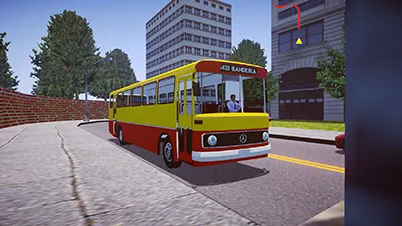
Mercedes O-365 'Monobloco' — work-in-progress mod (for Proton Bus Simulator Road, Monobloco, Brazil)
In Development

Mercedes O-365 'Monobloco'

Proton Bus Simulator Road Mercedes-Benz Monobloco Brazil
By Bus Simulation Channel
The Mercedes-Benz O-365 was one of the final Brazilian monobloco entries in a lineage that ran from the O-321 in the late 1950s through the O-400 in the mid-1990s. Launched in 1987 and produced for only two years until 1989, the O-365 brought a more powerful drivetrain and updated urban-operation systems to the monobloco line while preserving the integral-body silhouette that defined the family. Like its O-364 predecessor it sat heavily in the continuous-charter market — fleets serving factories, schools and office complexes — which had grown steadily through the 1960s and peaked in Brazil during the 1980s.

For Proton Bus Simulator Road this project targets the mechanical and acoustic character of the late-monobloco Mercedes platform. Driving feel on a chassis that integrated body and frame as one rigid unit is fundamentally different from the cab-on-chassis coach designs that dominated the 1990s onward, and the audio capture work is focused on isolating the engine-bay resonance the monobloco shell amplifies under load.

Current focus: external modeling and chassis silhouette are locked into the visual pass; interior compartment recreation and the engine sound mix across the operating range are the active work. No firm release date — the open question is the cabin audio polish before the chassis ships.
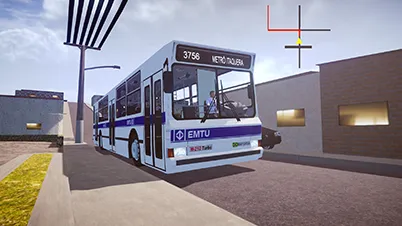
Mafersa M210 Turbo — work-in-progress mod (for Proton Bus Simulator Urbano, Urban, Brazil)
In Development

Mafersa M210 Turbo

Proton Bus Simulator Urbano Mafersa Urban Brazil
By Bus Simulation Channel
The Mafersa M210 Turbo was the turbocharged diesel iteration of the M210 chassis family built by Mafersa — Material Ferroviário S.A. of Brazil. Originally a rail-car manufacturer with more than 1,200 metro and railway cars to its name, Mafersa pivoted into urban bus chassis production in the early 1980s after drastic cuts in Brazilian public-sector rail investment forced the company to find a new market. The M210 platform, which also spawned a trolleybus variant and a third-party body version (M210-P), was sized for high-density urban service, carrying around 105 to 160 passengers in typical operator configurations of 37 seated and 91 standing.

For Proton Bus Simulator Urbano this project targets the specific character of high-capacity Brazilian city service on a domestic Mafersa chassis — the turbocharged six-cylinder pickup off the line, the way a long urban body sits on the M210's rear-engine platform under standing-passenger load, and the mechanical noise envelope distinct from the more common Mercedes-Benz and Scania-based fleets of the era.

External modeling and the chassis silhouette are progressing. The current focus is on the interior compartment and the audio mix for the turbocharged engine across idle, partial-throttle and full-load conditions. Release timing depends on remaining QA and animation passes — we publish updates here as each milestone lands rather than committing to a fixed date.
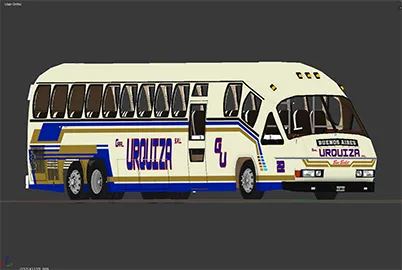
Cametal CX40 Scania — work-in-progress mod (for Proton Bus Simulator Road, Coach, Argentina)
In Development

Cametal CX40 Scania

Proton Bus Simulator Road Scania Coach Argentina
By Bus Simulation Channel
The Cametal CX40 is an Argentine intercity coach that premiered in late 1987 for the 40th anniversary of Carrocerías Metálicas, the Rosario-based body builder founded in 1947. Designed by Miguel Bustillo, its aerodynamic silhouette was unusually forward-looking for its era and remains visually distinctive nearly four decades later. The CX40 was typically mounted on the Scania K112 chassis in a 6x2 three-axle configuration, and at least three units were operated on long-distance services by Tucumán-based El Trébol between 1987 and 1989 with 47 reclining seats, on-board TV, minibar, and a chemical WC.

For Proton Bus Simulator Road, this project targets the engineering character that made the CX40 distinctive: the way a tag-axle 6x2 Scania chassis loads its rear bogie through high-speed sweepers, the throaty mechanical note of the K112's straight-six diesel under load, and the long-distance cabin layout with its premium amenities. The aerodynamic body shell is being modeled to match Bustillo's original 1987 lines, including the panoramic windshield curvature and the smooth sidewall transitions that broke with everything Argentine coach design had shown up to that point.

External modeling and the chassis silhouette are progressing through the visual lock phase. The current focus is on the interior compartment — recreating the 47-seat passenger cabin layout, animating the chemical WC door and the luggage compartments, and tuning the K112 sound mix across idle, partial throttle, and full-load conditions. No firm release date yet; the open question is the cabin audio polish and a closed-beta validation pass with operators familiar with the K112 driving characteristics on Argentine highway grades.

Frequently Asked Questions

When will a project be released?
Release timing is project-specific and depends on remaining QA, audio mix and animation passes. We publish updates here on /projects as each milestone lands rather than committing to a fixed date — the only honest schedule for a non-commercial sim mod.
How can I follow a project's progress?
Subscribe to the Bus Simulation Channel on YouTube — we post preview clips and behind-the-scenes captures as projects advance. The /projects page itself updates whenever the development status changes.
Will the mod be free?
Yes. Every mod on Proton Bus Mods is free to download. We rely on ad revenue and community support to keep building.