Why Hong Kong Runs the World's Densest Double-Decker Fleet
No city on earth leans on the double-decker bus like Hong Kong. In most places a two-deck bus is a tourist novelty or a British quirk. In Hong Kong it is simply the bus — the default machine that moves millions of people every day, in red, up and down some of the steepest, most crowded streets in the world.
So why does Hong Kong have so many double-decker buses? The short answer is geometry: a dense city with no spare road space had to build its buses up instead of out. The long answer runs from 20 Daimlers shipped from England in 1949 to the three-axle, air-conditioned super-decker you can drive today in Proton Bus Simulator. Here is the whole story.
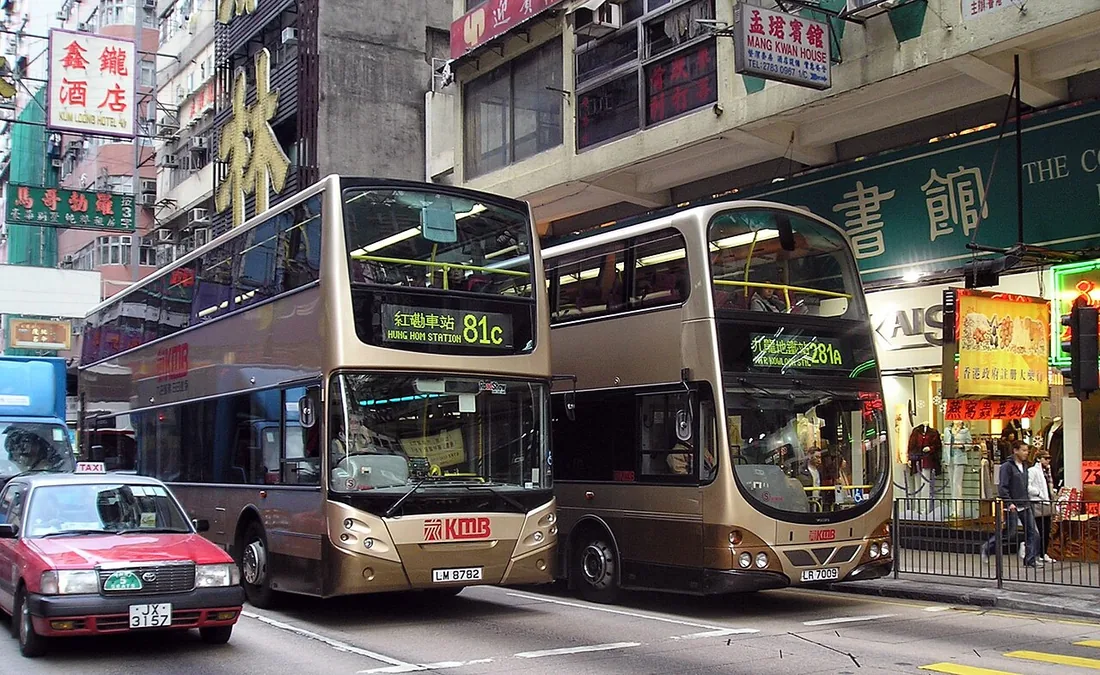
Why Hong Kong builds its buses up, not out
The logic is pure math. A street can only fit a bus so long before it can't turn a corner or pull into a stop. Hong Kong has some of the highest population density anywhere, packed onto a thin strip of buildable land between the harbour and the hills. Road space is fixed and precious.
Stacking a second deck roughly doubles the seats on the exact same footprint — no extra length, no extra lane, no extra driver. For a city this crowded, that is the difference between a working bus network and gridlock. Britain reached for the same answer in its own narrow cities (the story we tell in our history of the double-decker bus), and Hong Kong, then a British colony, inherited both the idea and the vehicles.
How it started: 20 Daimlers from England in 1949
Hong Kong's double-decker era begins in 1949, when Kowloon Motor Bus (KMB) imported 20 Daimler double-deckers from England and became the first operator to run them in the territory. The colonial link is the whole reason: the buses, the layout and the left-hand traffic all came straight from the British playbook.
They arrived later than you might expect. Double-deckers had been floated for Hong Kong years earlier, but war and the state of the roads held them back until the late 1940s — the city's first two-deck buses landed roughly a decade after the idea was first raised, as the South China Morning Post has recounted. Once they came, though, they never left. The double-decker fit Hong Kong so well that within a few decades it had crowded out almost everything else.
A near-total double-decker fleet: KMB and Citybus
Here is the number that makes Hong Kong unique: its big operators are almost entirely double-deck. This isn't a city that runs some double-deckers — it runs little else.
| Operator | Double-deckers | Share of fleet | Reported |
|---|---|---|---|
| Kowloon Motor Bus (KMB) | ≈3,750 | ≈96% | 2017 |
| Citybus | ≈950 | almost the entire fleet | 2021 |
Those figures shift year to year as fleets renew, but the shape doesn't: single-deckers in Hong Kong are the exception, used mainly on lightly-loaded or space-restricted routes. Everywhere else, the double-decker rules. KMB alone is one of the largest single-operator double-decker fleets on the planet.
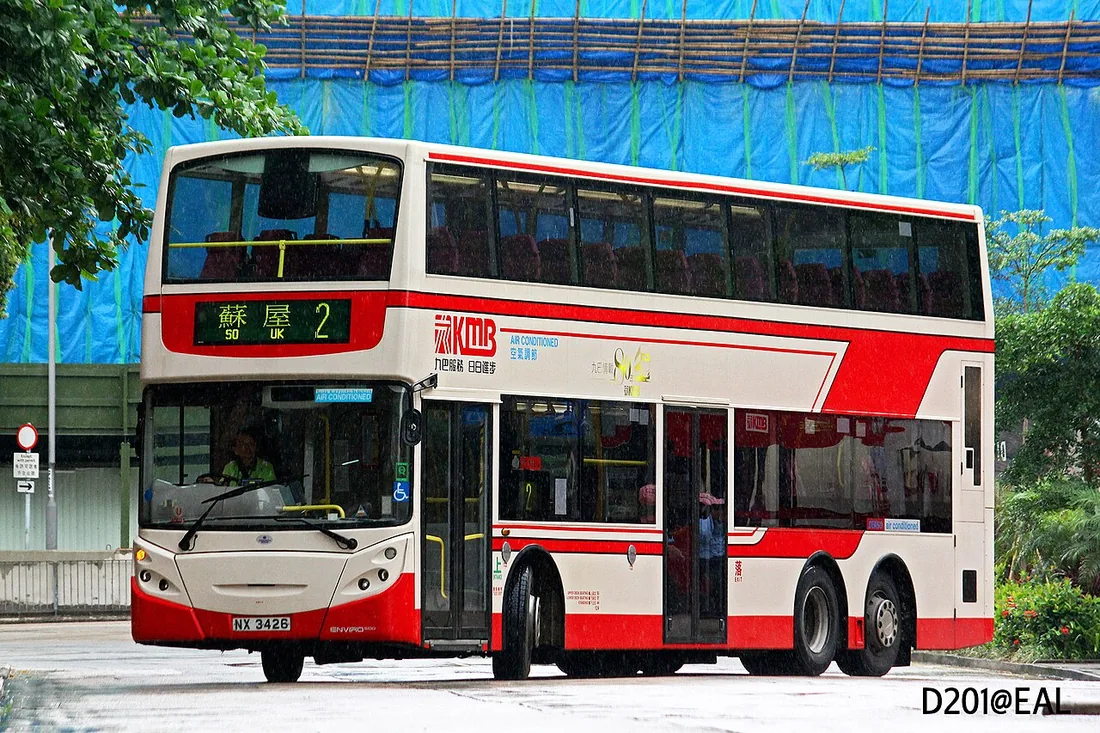
The Hong Kong super-decker: three axles, air-con, right-hand drive
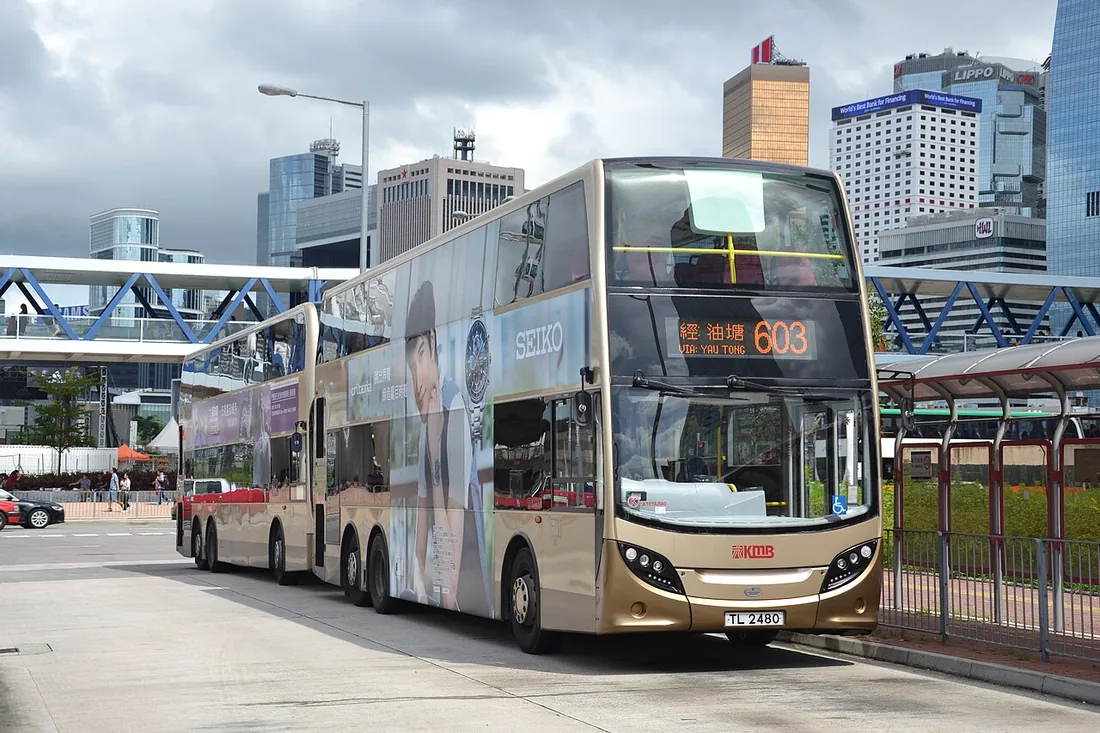
A Hong Kong double-decker is not a London double-decker. The British standard, like the Alexander Dennis Enviro400, is a two-axle bus around 10–11 metres long. Hong Kong runs the bigger sibling: the three-axle Enviro500, stretched to 12.8 metres, about 2.55 m wide and 4.4 m tall.
That third axle isn't decoration — it's a load-bearing necessity. A 12.8-metre bus carrying a full second deck of passengers is too long and heavy to sit legally on two axles, so it adds a rear tag axle to spread the weight. Per Alexander Dennis's own specifications, the Hong Kong Enviro500 uses a steered tag axle specifically "to ensure excellent manoeuvrability on routes serving the hills of the New Territories as well as in narrow city streets." The payoff is capacity: the 12.8 m version seats up to about 92 and carries up to roughly 144 people in total. KMB's Enviro500 fleet alone now runs to over 2,500 buses.
And because Hong Kong drives on the left, these are right-hand-drive buses — the same platform that goes left-hand drive for a rare export like Mexico City, but here in its natural home configuration.
From "hot dog" to air-conditioning: the 1988–2012 shift
For decades, Hong Kong's double-deckers had no air-conditioning — a punishing thing in a subtropical summer. Locals nicknamed the sweltering non-AC buses "hot dog" buses. That changed in 1988, when KMB put the territory's first successful air-conditioned double-decker (an 11-metre Leyland Olympian) into service. Air-con quickly became the expectation, and by 1995 KMB had stopped buying non-AC buses altogether.
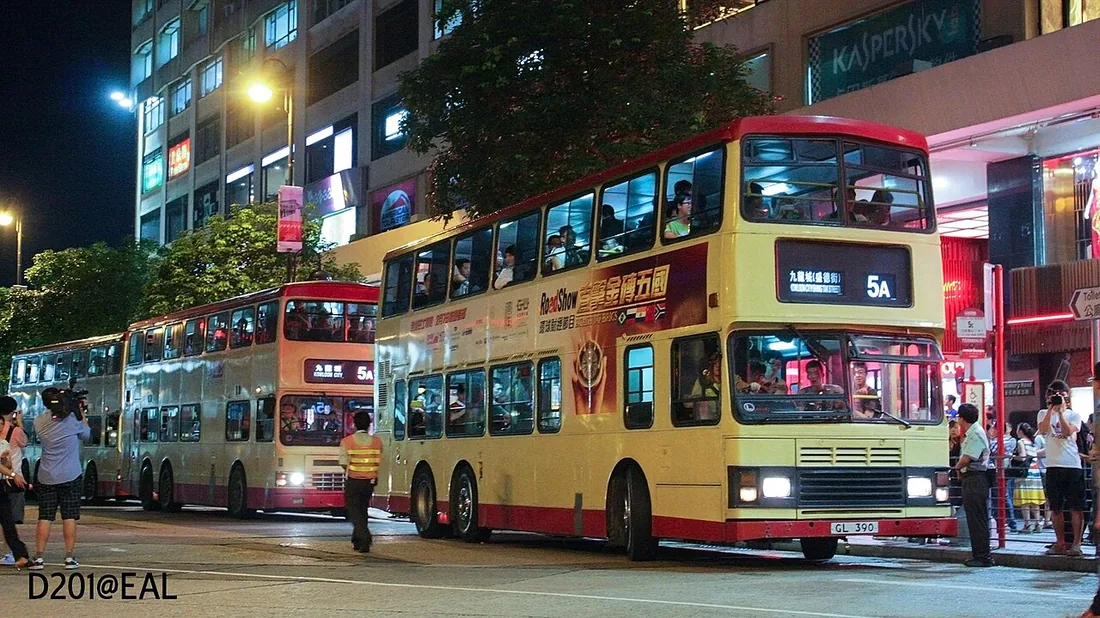
The last holdouts ran until 9 May 2012, when KMB upgraded its final four non-AC routes and retired the last "hot dogs" for good. That day marked the end of an era — every franchised bus in Hong Kong has been air-conditioned ever since.
KMB vs Citybus, and the Enviro500 duopoly
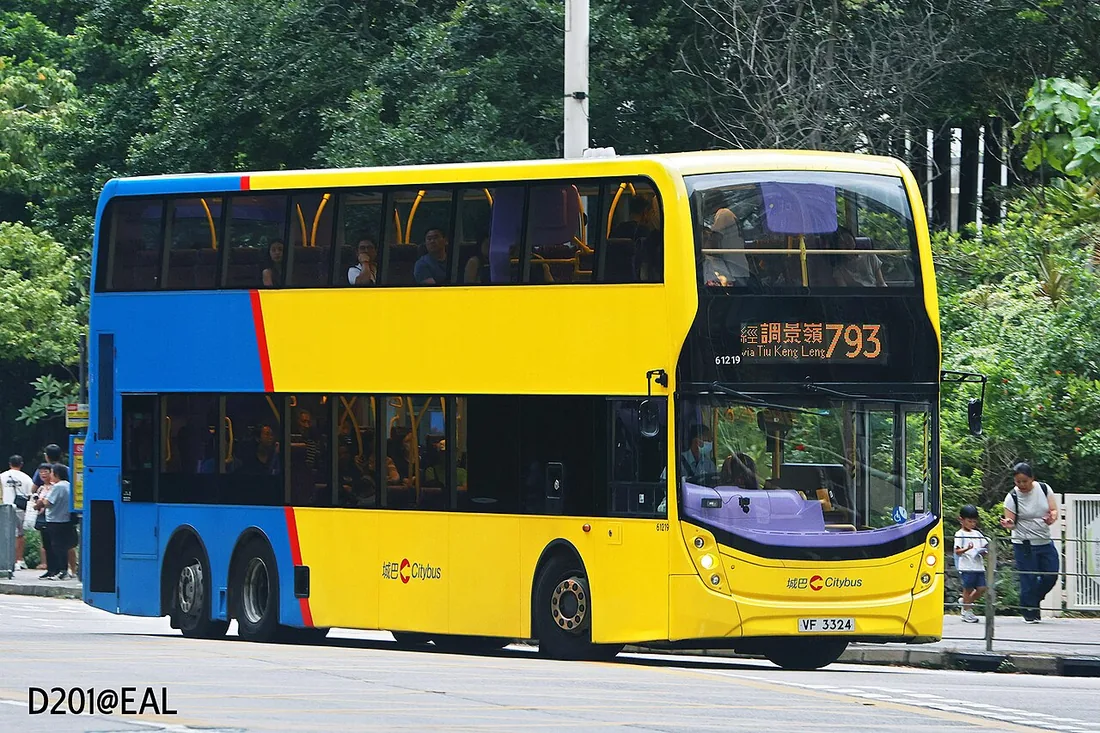
Two names cover most of Hong Kong's buses. KMB is the giant, running Kowloon and the New Territories and operating one of the world's largest bus fleets. Citybus covers much of Hong Kong Island and the airport routes. (A third operator, New World First Bus, merged into Citybus in 2023.)
On the vehicle side, the modern fleet is dominated by two suppliers: Alexander Dennis, whose Enviro500 is the definitive Hong Kong bus, and Volvo, long the other half of the market with the Olympian and later the B9TL. If you picture a red Hong Kong double-decker today, you are almost certainly picturing an Enviro500. You can browse the whole family on the Alexander Dennis mods hub.
What the Hong Kong double-decker feels like to drive
This is where the Hong Kong spec stops being trivia and starts changing how you drive. Take the three-axle Enviro500 into the sim and it behaves nothing like a short two-axle UK deck.
The steered tag axle is the first thing you feel. On a two-axle bus the rear simply follows the front through a bend. On the three-axle super-decker the back end tracks differently — you place the nose into a tight corner earlier and more deliberately, because there's a whole extra axle and two metres of bus swinging behind you. It's the exact trait Alexander Dennis engineered for those New Territories hills.
Then there's the high centre of gravity. Load 12.8 metres of bus with a full upper deck and the weight sits high and long. The body leans harder into roundabouts, and under braking the mass pitches forward from up top, so you brake in a straight line before the bend rather than through it. Right-hand drive adds the final twist: you're placing the bus from the other side of the cab. Driving one well on a steep, narrow Hong Kong-style route is constant management of height, length and weight all at once.
The best way to feel all of it is to drive the real thing: the AD Enviro500 MMC in KMB spec puts the three-axle, right-hand-drive Hong Kong super-decker in your hands. Take it up a tight hill and you'll understand why this city — and only really this city — turned the double-decker into the everyday standard.
FAQ
How many passengers does a Hong Kong double-decker bus carry?
Are Hong Kong buses electric?
Do Hong Kong buses run 24 hours?
Why did Hong Kong's first double-decker buses arrive so late?
Sources
- Alexander Dennis — Enviro500 (Asia Pacific) specifications — the 12.8 m three-axle dimensions, the steered tag axle "for routes serving the hills of the New Territories as well as narrow city streets," and passenger capacity.
- Hong Kong Transport Department — Fact Sheet on Transport — official data on Hong Kong's franchised bus operators and fleet.
- Background: History of bus transport in Hong Kong — Wikipedia — the 1949 arrival of KMB's first 20 Daimler double-deckers, the "hot dog" non-air-conditioned era, the 1988 first air-conditioned double-decker, and the 9 May 2012 retirement of the last non-AC buses.
- Background: Kowloon Motor Bus — Wikipedia — KMB's fleet scale and its roughly 96% double-decker share (2017).
- South China Morning Post — Hong Kong's first double-decker buses — the delayed arrival of the territory's first double-deckers.
Hero & illustrations via Wikimedia Commons: hero (KMB double-deckers at the Star Ferry terminus) by Simon_sees, CC BY 2.0; Nathan Road double-deckers by STA3816, CC BY-SA 3.0; three-axle Enviro500, Citybus Enviro500 MMC and the last-day "hot dog" bus by Samson Ng, CC BY-SA 4.0.