Van Hool: Belgium's Coach Giant and the 25-Metre Bendy Bus
Belgium is not the first country you think of for buses. Yet a family firm from a village near Antwerp quietly built some of the most extreme buses on Earth: the longest machine you can drive without rails, double-deck coaches that tour America, and tram-shaped vehicles that blur the line between bus and light rail.
That firm is Van Hool — a name most passengers have never noticed, and one that, after nearly 80 years, met a dramatic end in 2024. Here is its story, and why one of its buses is the ultimate challenge to drive.
A Belgian family firm
Van Hool was founded in 1947 by Bernard Van Hool, a farmer in Koningshooikt, near Lier in Belgium. It grew into a rare thing in the modern bus world: a large, independent, family-owned manufacturer that built both city buses and long-distance coaches — and exported them far beyond Europe. Van Hool became a familiar name on American highways, selling an average of around 600 coaches a year in the United States, an unusual feat for a European maker.
The 25-metre bendy giant: the AGG300
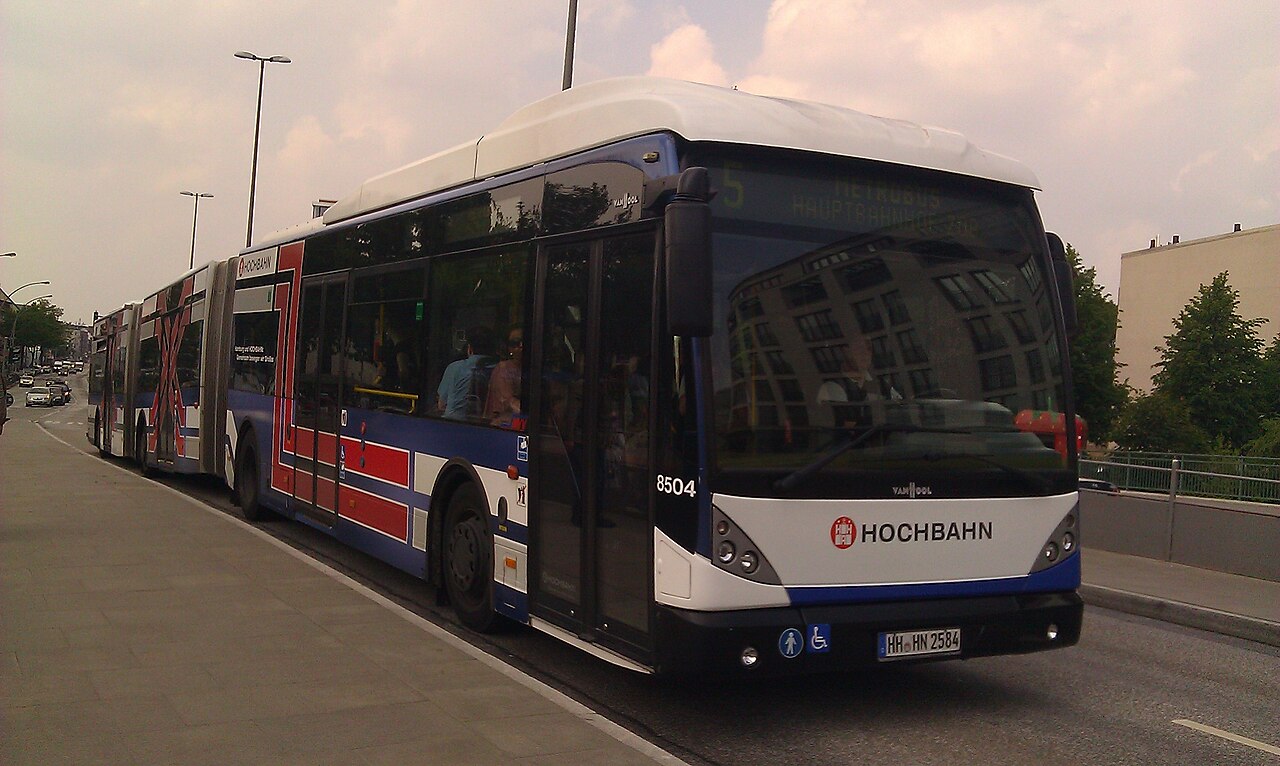
Van Hool's most spectacular product is a bus that bends twice. The AGG300 is a double-articulated bus — three sections joined by two concertina joints — stretching close to 25 metres, with four doors, a low floor, and room for well over 150 passengers. It is, in effect, a road-going train.
Unlike the bi-articulated giants of Latin America — which we told the story of in why buses bend twice — the AGG300 brought the format to European streets. It ran with ASEAG in Aachen from 2005 to 2019, and Hamburg's Hochbahn operated 26 of them on its busy Metrobus line 5 until 2018. On a high-demand corridor, one AGG300 does the work of two ordinary buses.
The tram that isn't: the ExquiCity
Van Hool's other big idea was to make a bus look like a tram. In 2011 it launched the ExquiCity, a platform built specifically for Bus Rapid Transit, styled with the smooth, rail-like face of a modern streetcar. It came in two lengths — the single-articulated ExquiCity 18 and the double-articulated ExquiCity 24 — and, tellingly, in almost every drivetrain going: trolleybus, diesel-electric hybrid, fuel-cell hybrid or full battery-electric.
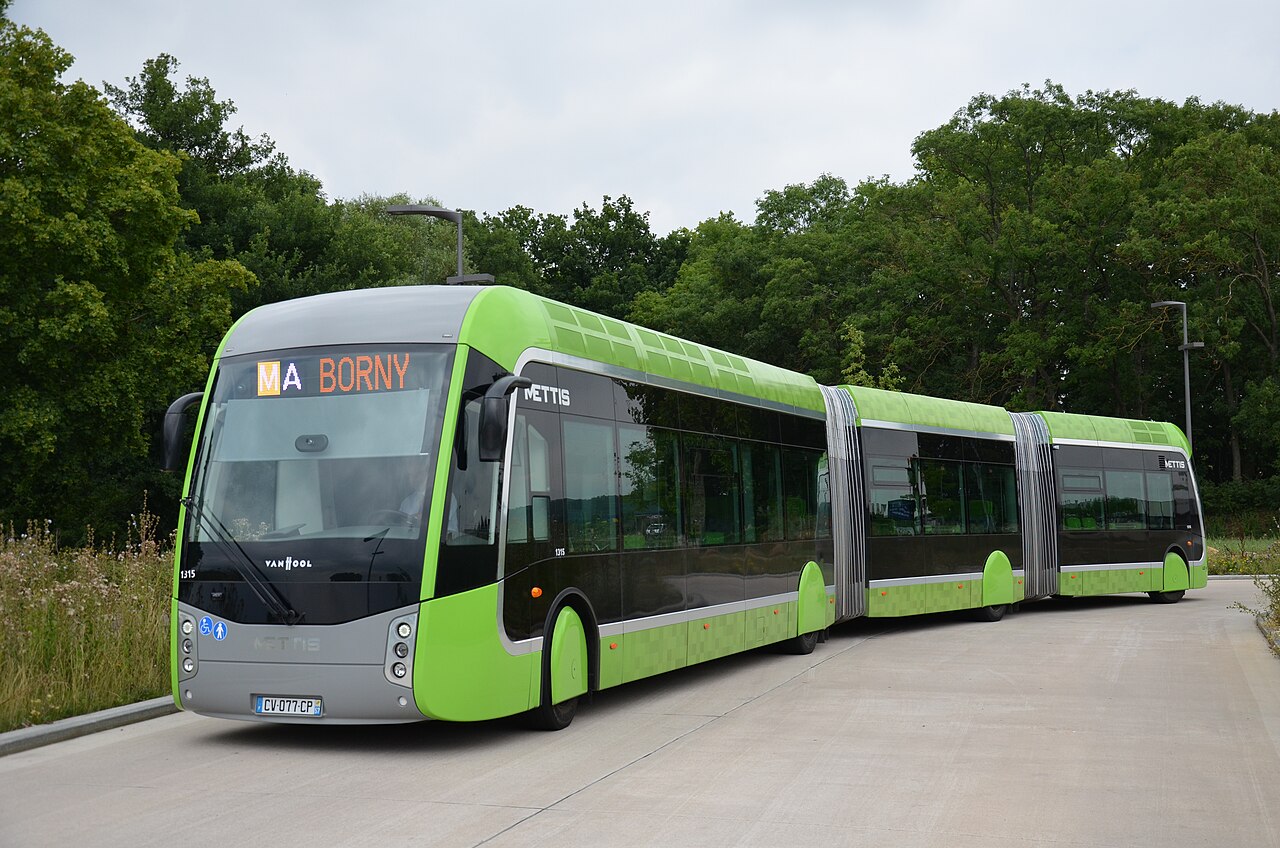
Cities like Metz built entire "bus rapid transit" identities around the ExquiCity's tram-like image — the prestige of light rail at the cost of a bus. It was Van Hool reading exactly where urban transport was heading.
Double-deck across the Atlantic: the Astromega
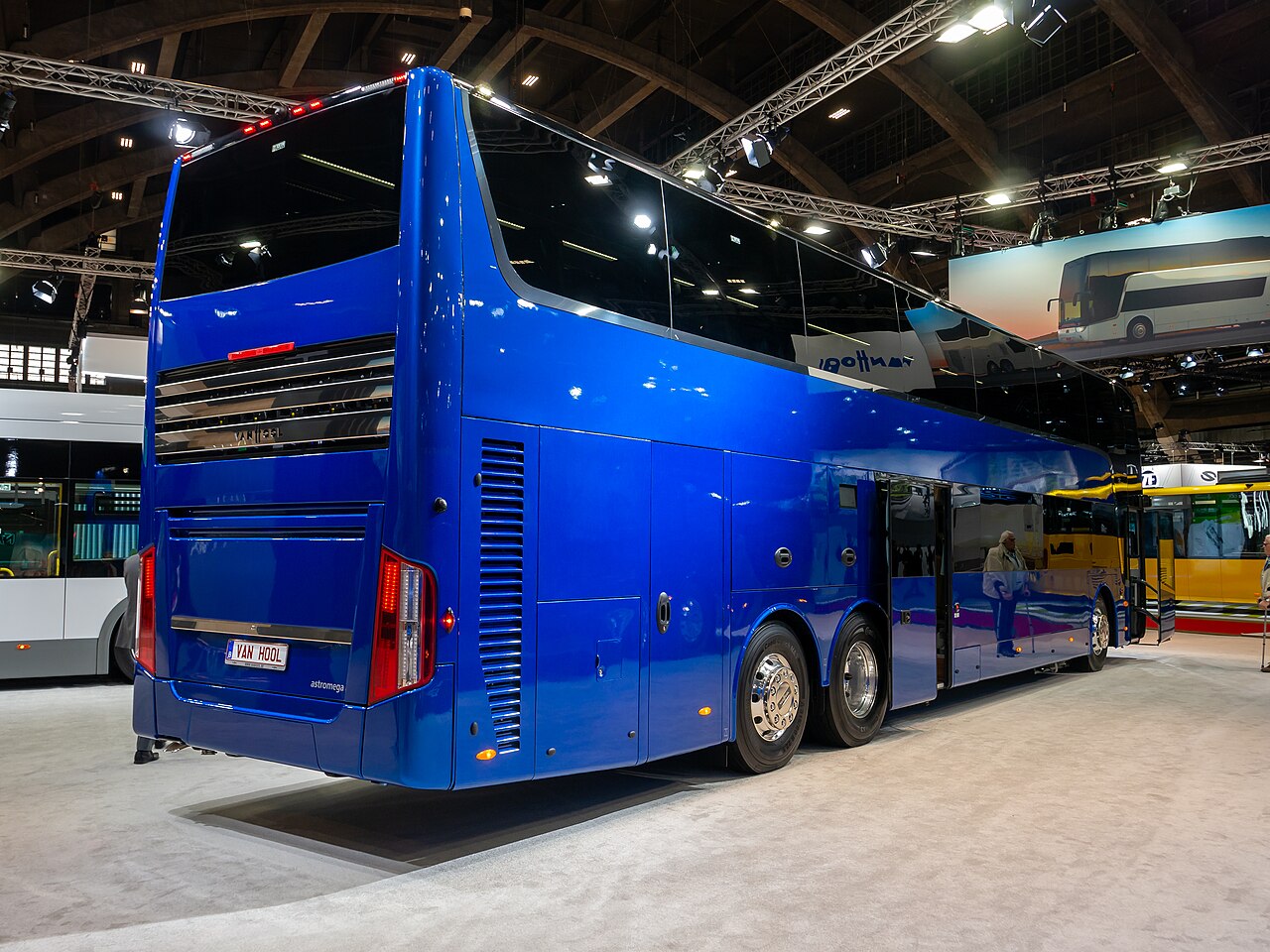
At the other end of the range sits the Astromega, Van Hool's double-decker touring coach (part of its TX/TDX families). Two full decks of reclining seats make it a favourite for premium long-distance and tour work, and it became one of Van Hool's signature exports — a Belgian double-decker rolling down American interstates and Japanese expressways alike.
What the giant feels like to drive
The AGG300 is the reason a Van Hool belongs in any serious sim garage: it is the ultimate spatial-awareness test. With two joints and three sections, a low-speed turn ripples back through the whole bus — the first section follows the cab, the second follows the first, and the tail tracks a path you must predict two joints ahead. Cut a corner and the rear sweeps across a lane you were sure was clear.
The trick, as with all these giants, is the road they were built for: on a wide, segregated busway the length feels majestic, but at a tight kerbside junction it feels like steering a train that has wandered off its rails. The Astromega adds the other Van Hool challenge — a tall, top-heavy double-decker that leans in bends and rewards smooth braking, a coach that thinks it's a building. Van Hool mods are rare, but you can drive the same breed of bi-articulated giant in the catalog.
The end of an independent giant
Van Hool's story has a sad final chapter. On 5 April 2024 the company filed for bankruptcy and was declared bankrupt the following Monday. Its bus and coach activities were taken over by the Dutch manufacturer VDL (together with Schmitz Cargobull for the trailer side). After 77 years, one of Europe's last big independent, family-owned bus makers was gone — folded, like so many before it, into a larger group. The extreme buses remain on the road; the independent Belgian name that dared to build them does not.
FAQ
What is Van Hool?
What is the Van Hool AGG300?
What is the Van Hool ExquiCity?
What happened to Van Hool?
Sources
- Van Hool — Wikipedia — the 1947 founding by Bernard Van Hool at Koningshooikt; the coach and bus range (Astromega, ExquiCity); ~600 US coaches a year; the April 2024 bankruptcy and VDL takeover.
- Van Hool AGG300 — Wikipedia — the double-articulated ~25 m, four-door low-floor bus; service with ASEAG in Aachen (2005–2019) and Hamburger Hochbahn (Metrobus line 5, retired 2018).
- Bi-articulated bus — Wikipedia — the double-articulated format (two joints, three sections) and its use in high-capacity BRT service.
Hero & figures via Wikimedia Commons: hero (Van Hool AGG300, Hamburg) — Mirko Riemer, CC BY-SA 3.0; ExquiCity 24 (Metz) — Florian Fèvre, CC BY-SA 4.0; Astromega — MB-one, CC BY-SA 4.0.